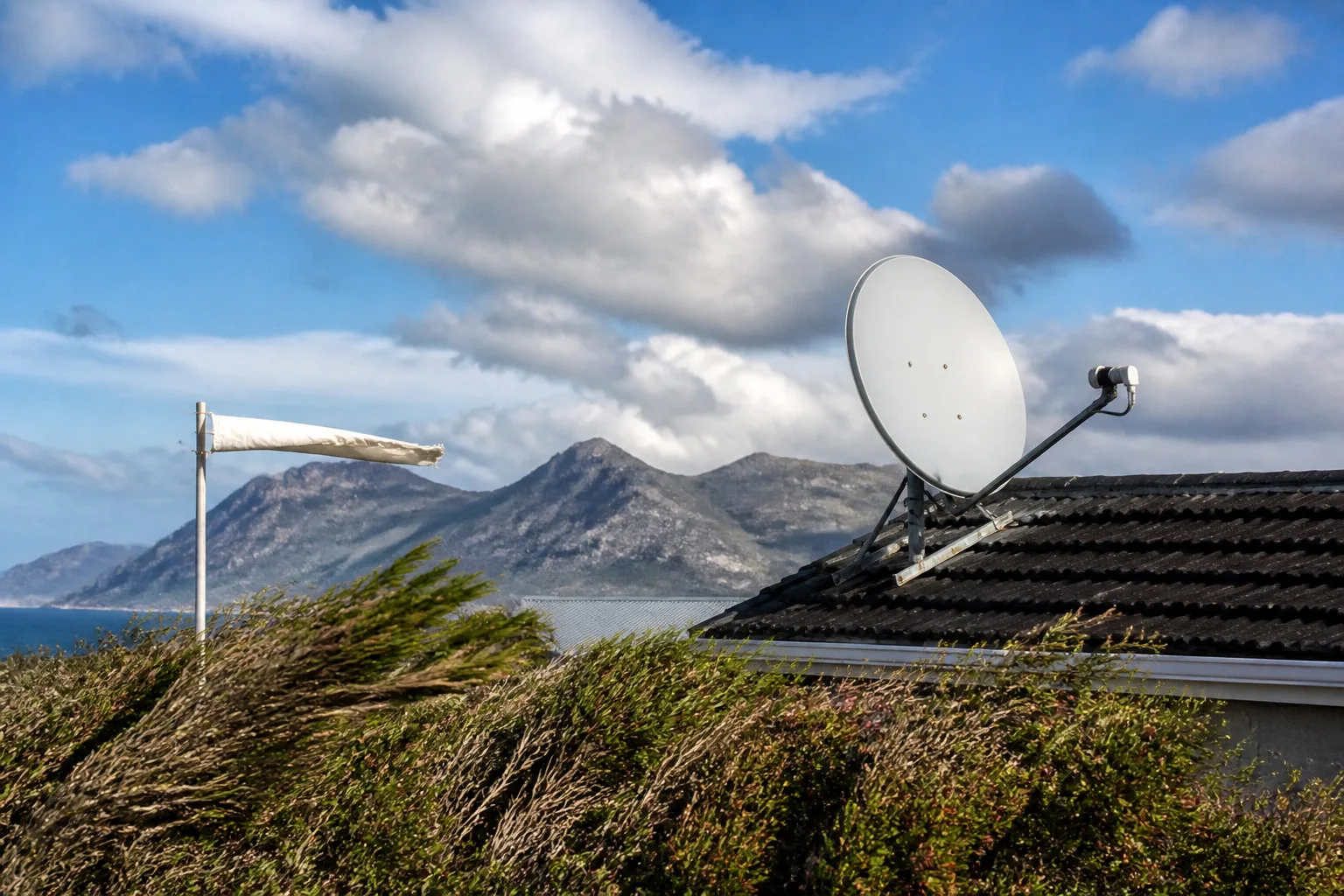
If your picture freezes or vanishes whenever the wind picks up, you are not imagining it. The south-easter that funnels off the Kogelberg mountains and across Betty's Bay is one of the most consistent dish-killers we deal with on the whole Overberg coast. It is also one of the most preventable: once a dish is mounted and aligned for these conditions, it stays put.
A satellite dish is a precision instrument pretending to be a piece of garden furniture. It has to point at a single satellite roughly 36,000 km away, accurate to within a fraction of a degree. Move it a few millimetres at the dish face and you have moved the aim by hundreds of kilometres up in orbit. That is why a setup that looks perfectly solid can still drop its signal: the margin for error is tiny.
What the wind actually does
The wind does not usually rip a dish off a wall in a single gust: that is rare. What it does is far more insidious. Day after day, the south-easter applies steady pressure and vibration to the dish and its bracket. Over a season that constant load works fixings loose, lets the dish creep a degree or two off true, and slowly opens up any join that was not properly tightened or sealed in the first place.
You see the result as a picture that is fine in calm weather but pixelates, freezes or disappears the moment the wind gets up: often with the E48-32 no-signal error on screen. Because it comes and goes with the weather, plenty of people assume it is a problem with DStv's broadcast or their subscription. Nine times out of ten on this coast, it is a mechanical problem at the dish.
Why a quick nudge never lasts
The temptation: and what a lot of rushed call-outs amount to: is to climb up, push the dish roughly back to where the picture returns, and leave. It works for a week. Then the next blow arrives and you are back to square one, because nothing has actually been fixed: the same loose bracket is still loose, and the same under-spec mounting is still under-spec.
Proper satellite dish alignment is a different job. We re-aim the dish to peak signal strength using a meter: not by eye, and not just to the point where the picture happens to come back: and then we deal with the reason it drifted in the first place:
- Marine-grade brackets and fixings rated for sustained coastal wind load, not the lightweight hardware that ships with a budget kit.
- The mount anchored into something solid, in a position that has clean line-of-sight without sitting in the teeth of the worst gusts where it can be avoided.
- Every nut torqued properly and every join re-sealed, so vibration cannot work it loose again.
- A final signal-strength and quality reading recorded on site, so we know it is genuinely on target and not just "good enough" for a calm afternoon.
Corrosion makes it worse
Wind rarely travels alone here: it carries salt. Salt air corrodes brackets, bolts and the LNB at the end of the arm, and corrosion both weakens the mount and degrades the signal. A dish that is drifting in the wind and quietly corroding at the same time will fail far faster than either problem alone. It is why we treat alignment and weather-sealing as one job, and why we wrote a separate piece on preventing salt-air corrosion that is worth a read if your gear is more than a couple of years old.
How to tell it is the wind and not something else
A few signs point clearly at alignment and mounting rather than the decoder or your account:
- The picture is reliable in still weather and only fails when it is blowing.
- The fault has crept in gradually over a season, rather than appearing overnight.
- You can see visible rust on the bracket, bolts or LNB, or the dish visibly moves when you push it.
- It started after a particularly big south-easter or a storm.
If that sounds like your setup, the underlying E48-32 error has a handful of usual causes, and a wind-shifted dish is top of the list on this coast.
The bottom line
Our DStv installation team in Betty's Bay mounts every dish for this coast's wind from day one, so you are not fighting the south-easter every season.
If your dish needs realigning every season, it was never mounted for Betty's Bay in the first place. A dish set up for inland conditions will always struggle where the mountains meet the sea. The fix is not more frequent call-outs: it is one job done properly: re-aligned to peak signal, mounted for the wind and sealed against the salt. We cover Betty's Bay, Pringle Bay, Rooi Els, Kleinmond and the rest of the Overberg coast, and most wind-related faults are a same-day sort-out. Book a technician and we will get your signal stable and keep it that way.